Why Small Healthcare Practices Are Exposed
You focus on patients. Meanwhile, your digital footprint is publicly visible, and HIPAA requires you to protect it.
You run a practice. You focus on patients. Meanwhile, your digital footprint is publicly visible. Email configuration, website software versions, staff addresses, exposed documents. You're required by law to protect patient data, but nobody told you how or what to check. Most small practices have significant exposures they don't know about. OCR launched its Risk Analysis Initiative in 2024 and is actively investigating and fining practices that lack a documented security risk assessment.
See the full process →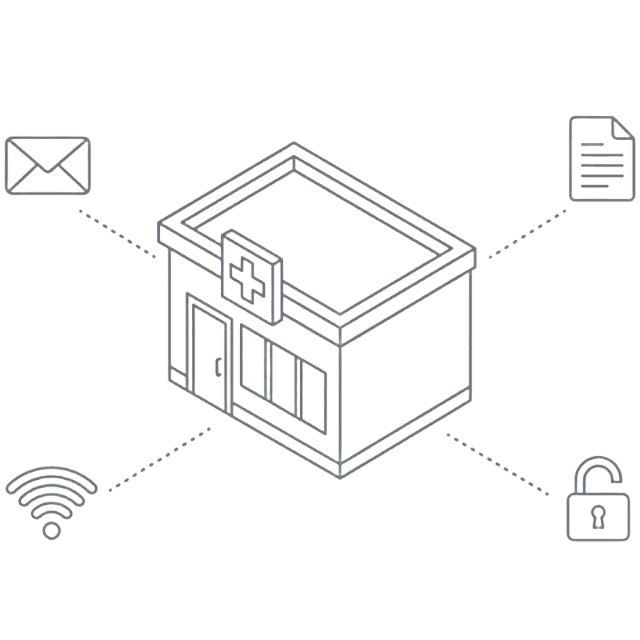
What the law requires vs. what most practices actually have
Common exposures at small practices
No SPF, DKIM, or DMARC records. Anyone can send email appearing to be from your practice.
Patient-facing portals with outdated encryption. A direct HIPAA Technical Safeguards finding.
Practice email addresses found in known data breaches. Credentials may be compromised.
CMS versions with known vulnerabilities that are publicly visible and listed in security databases.
Portals lacking HSTS, CSP, and X-Frame protection. Standard technical safeguards.
Internal forms, schedules, or patient documents accidentally exposed in search results.
Recent HIPAA enforcement actions
In 2024, OCR launched its Risk Analysis Initiative, an enforcement program targeting compliance with the HIPAA Security Rule's risk analysis provision. Through 2025, OCR announced ten HIPAA settlements citing risk analysis failures, with penalties ranging from $25,000 to $3,000,000.
Penalty tiers (2025 inflation-adjusted): Tier 1 (didn't know): $145–$73,011. Tier 2 (reasonable cause): $1,461–$73,011. Tier 3 (willful, corrected): $14,602–$73,011. Tier 4 (willful, not corrected): $73,011–$2,190,294. Annual cap: $2,190,294 per identical provision. Source: 45 CFR 160.404, HHS 2025 inflation adjustment.
Sources: HHS OCR Enforcement Highlights (hhs.gov), OCR Phase 2 HIPAA Audit Industry Report (2018), 45 CFR 160.404 (2025 inflation adjustment), OCR Risk Analysis Initiative enforcement actions (2024-2025).